Tim Instructions
← Back to product pageBuild Difficulty: Easy
Components
| C1 | 47nF |
| C2 | 100pF |
| C3 | 39nF |
| C4 | 1uF Film/Monolithic |
| C5 | 10nF |
| C6 | 1uF Film/Monolithic |
| C7 | 47uF Electrolytic |
| C8 | 47uF Electrolytic |
| R1 | 2M2 |
| R2 | 510K |
| R3 | 3K3 |
| R4 | 3K3 |
| R5 | 1K5 |
| R6 | 3K3 |
| R7 | 3K3 |
| R8 | 8K2 |
| R9 | 10K |
| D7 | 1N4001 |
| IC1 | LM4558 |
| VOL | 10K Log |
| BASS | 50K Log |
| CLIP | 2 Way DIP Switch |
| D1-D6 | 1N4148 |
| DRIVE | 1M Log |
| TREBLE | 50K Log |
Build Notes
Where capacitor type isn't specified, you can use monolithic ceramic or film type.
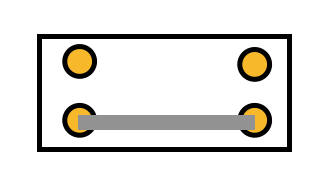
The clipping switch lets you add or remove additional diodes to the circuit for more/asymmetrical clipping with the DIP switch. If you want to permanently add them into the circuit then solder a jumper wire between the switch contacts as shown below. Alternatively if you don't want this option then you can leave out the DIP switch, D5 and D6.
Some versions of this circuit have a connection between the diodes, you have the option of soldering a jumper wire between J1 and J2 to do this or leave it out if you don't want it (it sounds just fine without it in my opinion).
Board Connections
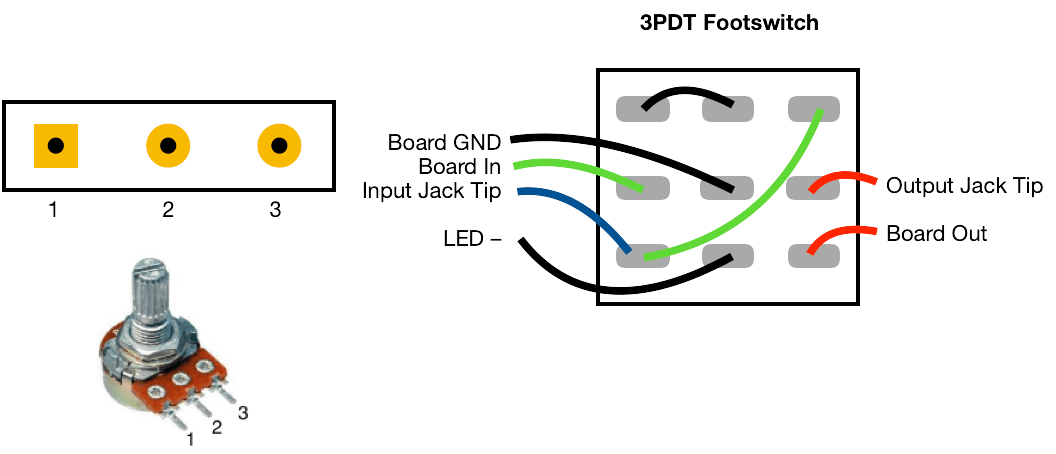
The PCB connections are labelled as the following: I - Input, O - Output, V - 9V DC in, G - Ground Potentiometers are connected from pin 1 to the square pad on the PCB.
This board was designed so you can use right-angle board mount potentiometers on it if desired, otherwise you will need to solder wired from the pads to the correct pin/lug.
Jack sleeves and DC centre pin should be connected to ground. V, LED + with a 2K2 resistor in series should be connected to the positive pin of the DC connector.