EP Booster Instructions
← Back to product pageBuild Difficulty: Easy
Components
| C1 | 47nF Film/Ceramic |
| C2 | 3n3 Film/Ceramic |
| C3 | 10uF Electrolytic |
| C4 | 10uF Electrolytic |
| C5 | 100uF Electrolytic |
| C6 | 10uF Electrolytic |
| C7 | 10uF Electrolytic |
| C8 | 100uF Electrolytic |
| R1 | 1M |
| R2 | 33K |
| R3 | 1M |
| R4 | 4K7 |
| R5 | 8K2 |
| R6 | 1K |
| R7 | 15K |
| R8 | 10K |
| R9 | 10K |
| R10 | 1M |
| R11 | 10K |
| R12 | 47K |
| R13 | 100R |
| BOOST | 10K Reverse Log |
| Q1 | MMBF5457 |
| Q2 | 2N5088 |
| Q3 | 2N5457 |
| S1 | 2 Way DIP Switch |
Build Notes
Because it is getting harder to find genuine 2N5457 JFET parts (cheap ones on eBay are fake) this PCB has the option to use a surface mount part Q1 instead. You only need to use Q1 or Q3 not both! The DIP switch is used to engage the brightness or EQ boost, try the settings before you screw the back of the case on and see which you like best. A reverse log pot gives a better volume sweep, but you can use a linear one if you can't find a C10K pot.
Board Connections
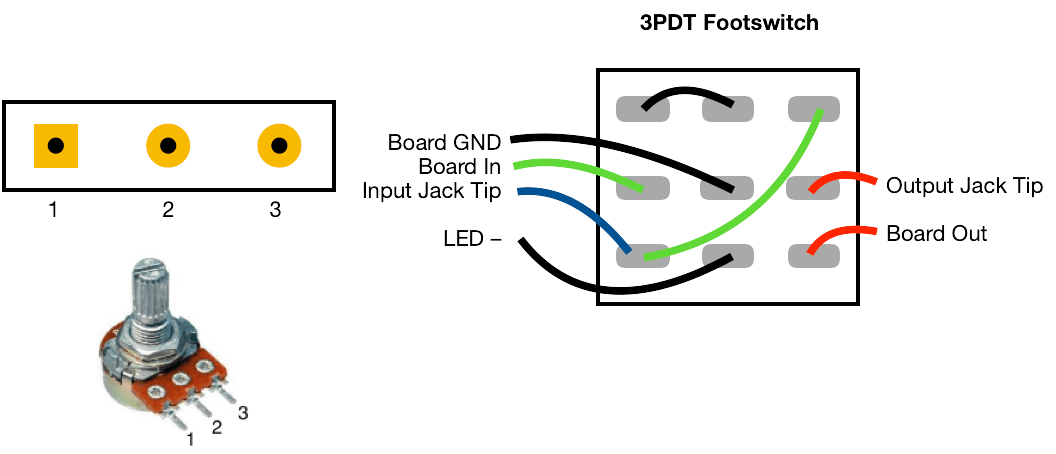
The PCB connections are labelled as the following: I - Input, O - Output, V - 9V DC in, G - Ground Potentiometers are connected from pin 1 to the square pad on the PCB.
This board was designed so you can use right-angle board mount potentiometers on it if desired, otherwise you will need to solder wired from the pads to the correct pin/lug.
Jack sleeves and DC centre pin should be connected to ground. V, LED + with a 2K2 resistor in series should be connected to the positive pin of the DC connector.